Hire Full-Stack Developers

Scrums.com's 10,000+ software developer talent pool includes experts across a wide array of software development languages and technologies giving your business the ability to hire in as little as 21-days.

13+

Years of Service

94%

Client Renewal Rate

10,000+

Vetted Developers

<21-Days

Ave. Onboarding

"Scrums.com has been a long-term partner of OneCart. You have a great understanding of our business, our culture and have helped us find some real tech rockstars. Our Scrums.com team members are high-impact, hard working, always available, and fun to have around. Thanks a million!"
CTO, OneCart
On-demand marketplace connecting users and top retailers
"The Scrums.com Team is always ready to take my call and assist me with my unique challenges. No problem is to big or small. Great partner, securing strong talent to support our teams."
CIO, Network
Leading digital payments provider
"Finding great developers through Scrums.com is easier than explaining to my mom what I do for a living. Over the past couple of years, their top-tier devs and QAs have plugged seamlessly into Payfast by Network, turbo-charging our sprints without a hitch."
Engineering Manager, PayFast by Network
A secure digital payment processor for online businesses
"Our project was incredibly successful thanks to the guidance and professionalism of the Scrums.com teams. We were supported throughout the robust and purpose-driven process, and clear channels for open communication were established. The Scrums.com team often pre-empted and identified solutions and enhancements to our project, going over and above to make it a success."
CX Expert, Volkswagen Financial Services
Handles insurance, fleet and leasing
"The Scrums.com teams are extremely professional and a pleasure to work with. Open communication channels and commitment to deliver against deadlines ensures successful delivery against requirements. Their willingness to go beyond what is required and technical expertise resulted in a world class product that we are extremely proud to take to market."
Product Manager, BankservAfrica
Africa's largest clearing house
“Scrums.com Team Subscriptions allow us to easily move between tiers and as our needs have evolved, it has been incredibly convenient to adjust the subscription to meet our demands. This flexibility has been a game-changer for our business. Over and above this, one of their key strengths is the amazing team members who have brought passion and creativity to our project, with enthusiasm and commitment. They have been a joy to work with and I look forward to the continued partnership.”
CEO & Co-Founder, Ikue
World's first CDP for telcos
“Since partnering with Scrums.com in 2022, our experience has been nothing short of transformative. From day one, Scrums.com hasn't just been a service provider; they've become an integral part of our team. Despite the physical distance, their presence feels as close and accessible as if they were located in the office next door. This sense of proximity is not just geographical but extends deeply into how they have seamlessly integrated with our company's culture and identity.”
SOS Team, Skole
Helping 60k kids learn, every day
"Scrums.com joined Shout-It-Now on our mission to empower young women in South Africa to reduce the rates of HIV, GBV and unwanted pregnancy. By developing iSHOUT!, an app exclusively for young women, and Chomi, a multilingual GBV chatbot, they have contributed to the critical task of getting information & support to those who need it most. Scrums.com continues to be our collaborative partner on the vital journey."
CX Expert, iShout
Empowering the youth of tomorrow
"Scrums.com has been Aesara Partner's tech provider for the past few years; and with the development support provided by the Scrums.com team, our various platforms have evolved. Throughout the developing journey, Scrums.com has been able to provide us with a team to match our needs for that point in time."
Founder, Aesara Partners
A global transformation practice
Why Scrums.com

Why Hire Full-Stack from Scrums.com

Globe icon

Africa Advantage

Access world-class developers at 40-60% cost savings without compromising quality. Our 10,000+ talent pool across Africa delivers enterprise-grade engineering with timezone overlap for US, UK, and EMEA markets.

Sparkle icon

AI-Enabled Teams

Every developer works within our AI-powered SEOP ecosystem, delivering 30-40% higher velocity than traditional teams. Our AI Agent Gateway provides automated QA, code reviews, and delivery insights.

Analytics icon

Platform-First Delivery

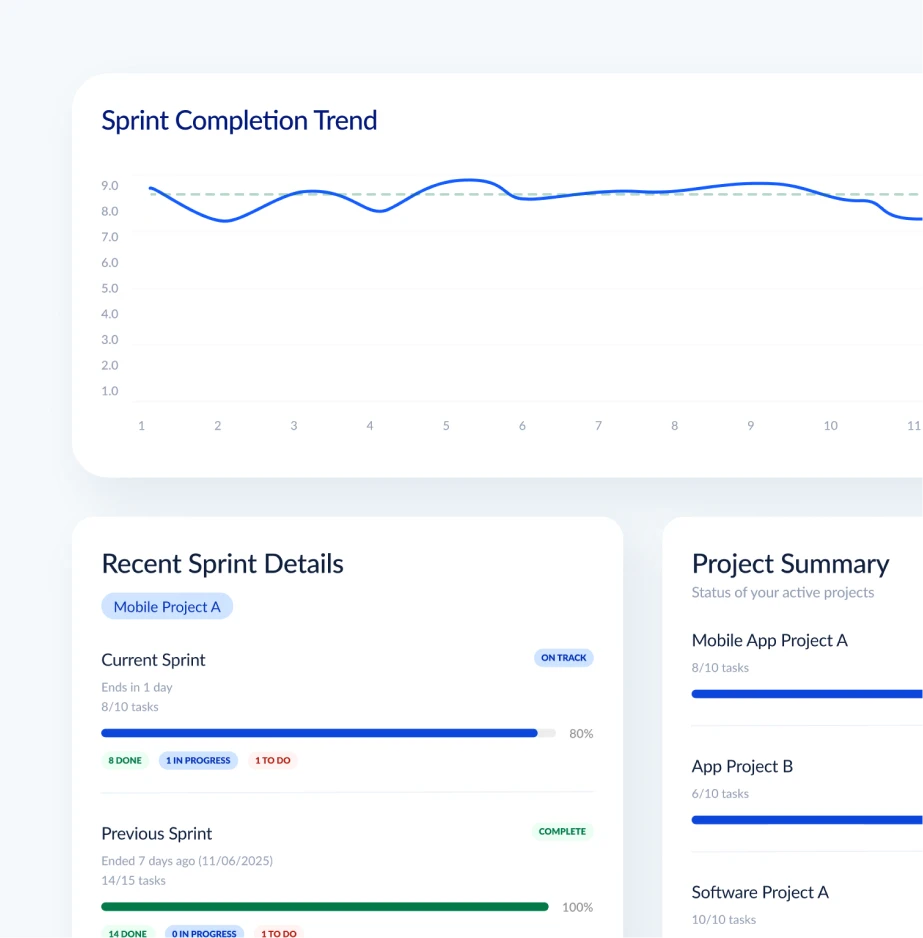
Get real-time development visibility into every sprint through our Software Engineering Orchestration Platform (SEOP). Track velocity, blockers, and delivery health with executive dashboards.

Use Cases

What You Can Build with Full-Stack

Double tick icon

Architect for Scale Without Rewriting Core Systems

Founder-built applications achieve product-market fit but show strain at scale: monolithic code, tangled dependencies, unclear layer boundaries. Full-stack developers architect systematic improvements—proper APIs, frontend/backend separation, testing automation, deployment pipelines—while maintaining momentum toward next milestone.
Double tick icon

Ship Features Without Handoff Delays Between Teams

Frontend/backend team dependencies create coordination overhead. One developer communicates intent, other interprets it, miscommunication surfaces in production. Full-stack developers eliminate this friction—understanding both perspectives, designing APIs frontends consume effortlessly, enabling simultaneous advancement.
Double tick icon

Own Complete Features From Concept to Production

Traditional specialization splits responsibility: frontend ships, backend ships separately, deployment happens last. Full-stack ownership inverts this—one developer shepherds feature through all layers, accountable for end-to-end performance, enabling rapid iteration and faster feedback loops.
Double tick icon

Manage Technical Debt Systematically During Growth

High-growth applications accumulate debt: database schemas built for 1K users struggling at 1M, APIs designed for internal teams now serving mobile clients and third parties. Full-stack developers address debt surgically without freezing feature work—optimizing systematically as they ship.
Double tick icon

Debug Performance Across All System Layers

Slow features hide in multiple places: frontend render cost, network latency, or slow API response. Full-stack developers trace bottlenecks across boundaries, optimizing end-to-end—frontend developers miss backend indexing problems, backend developers miss render-blocking JavaScript.
Double tick icon

Scale Lean Teams That Compound in Effectiveness

Startups can't afford frontend+backend+DevOps specialization. Full-stack developers ship complete products with minimal headcount—validating hypotheses, gathering customer feedback, iterating rapidly—essential for startup velocity and capital efficiency.
Our Process

How to Hire Full-Stack with Scrums.com

Align

Tell us your needs

Book a free consultation to discuss your project requirements, technical stack, and team culture.

Review

We match talent to your culture

Our team identifies pre-vetted developers who match your technical needs and team culture.

Meet

Interview your developers

Meet your matched developers through video interviews. Assess technical skills and cultural fit.

Kick-Off

Start within 21 days

Developers onboard to SEOP platform and integrate with your tools. Your first sprint begins.

Engagement Models

Flexible Hiring Options for Every Need

Whether you need to fill developer skill gaps, scale a full development team, or outsource delivery entirely, we have a model that fits.

Fill Specific Skill Gaps

Augment Your Team

Embed individual developers or small specialist teams into your existing organization. You manage the work, we provide the talent.

Integrate with your existing team
You manage developers directly
Flexible month-to-month contracts
Scale up or down as needed
Quick deployment (<21 days)
Full Teams Managed on SEOP

Dedicated Team

Get a complete, self-managed team including developers, QA, and project management – all orchestrated through our SEOP platform.

Fully managed by Scrums.com PM
Integrated into SEOP platform
Real-time delivery dashboards
Includes PM, Dev, QA roles
Quick deployment (<21 days)
Outcome-Based Delivery

Product Development

From discovery to deployment, we build your entire product. Outcome-focused delivery with design, development, testing, and deployment included.

Full product team (PM, Design, Dev, QA)
Design-to-dev process
2-week sprint cycles
Seamless handoff or ongoing support
Quick deployment (<21 days)
Not sure which model fits your needs? Book a Free Consultation

Access Talent Through The Scrums.com Platform

When you sign-up to Scrums.com, you gain access to our Software Engineering Orchestration Platform (SEOP), the foundation for all talent hiring services.

Browse Full-Stack across 113 technologies

View developer profiles, CVs, and portfolios in real-time

Activate Staff Augmentation or Dedicated Teams directly through your workspace

Scrums.com SEOP platform dashboard showing available talent with talent filtering and real-time hiring capabilities

Need Software Developers Fast?

Deploy vetted developers in 21 days.
Tell us your needs and we'll match you with the right talent.

The Role of Full-Stack in Software Development

Full-Stack Development: Strategic Choice for Shipping Speed

End-to-End Ownership Across Database, API, Frontend, and Deployment

When you're hiring full-stack developers, you're evaluating a strategic choice: hire specialists for each layer (separate frontend engineer, backend engineer, DevOps engineer) or generalists with end-to-end capability. Full-stack development isn't a fallback for startups—it's a deliberate composition strategy optimizing for iteration speed, knowledge distribution, and cost efficiency.

Full-stack adoption reflects market reality: startups default to full-stack (necessity), but large organizations increasingly hire full-stack developers, recognizing that siloed specialists slow shipping. Cross-functional research shows full-stack teams ship features 20–40% faster than specialized teams, primarily because coordination overhead vanishes. One developer owns database design through user-facing experience—no handoffs, no interpretation gaps, no waiting.

Core advantage: iteration speed through eliminated communication overhead and end-to-end accountability. When one developer understands the entire system, decisions accelerate (no coordination required), debugging simplifies (understands all layers), and optimization becomes systematic (sees bottlenecks across boundaries). Trade-off: full-stack developers are generalists with production breadth, not deep specialists—they understand frontend patterns broadly, not every CSS edge case; they design databases well, not as a DBA would.

Full-stack excels in: startups optimizing for shipping speed, feature teams maximizing autonomy, organizations where iteration speed drives competitive advantage, and applications where layer coupling is acceptable (which covers most web applications). Full-stack struggles with: systems requiring specialized expertise (machine learning infrastructure, high-frequency trading, embedded systems), large organizations with strict architectural governance, or applications where any layer requires world-class expertise.

At Scrums.com, our full-stack developers bring production experience shipping complete applications: architecting databases and APIs, building responsive interfaces, automating deployments, and scaling applications through growth phases. Whether you need Staff Augmentation to accelerate feature delivery, Dedicated Teams assuming complete product ownership, or Product Development as a Service, our engineers deliver working applications end-to-end without architectural handoffs.

Full-Stack Developer Competencies: Breadth with Production Depth

Proficiency Across All Layers, Specialized Depth in Core Concerns

Full-stack developers demonstrate production competency across frontend (React/Vue/Angular), backend runtimes (Node.js/Python/Java), databases (SQL/NoSQL), DevOps (containers, CI/CD), and cross-cutting concerns (APIs, authentication, caching, monitoring).

Frontend Proficiency: Modern JavaScript frameworks (React, Vue, Angular), component architecture, state management, performance optimization. Full-stack developers aren't deep specialists—they master frameworks in weeks, not years. Production competency covers: user experience trade-offs (single-page vs. server-rendered), accessibility standards, responsive design, and frontend performance impact on conversion (slower sites lose customers).

Backend Competency: Building APIs, query optimization, authentication/authorization, error handling, logging, and operational visibility. Language fluency in at least one backend runtime (JavaScript/Node.js, Python, Java, Go, C#). Production competency: RESTful and GraphQL API design, proper HTTP semantics, stateless architecture, horizontal scaling patterns, and idempotent operations.

Database Design and Optimization: Relational (SQL) and document (NoSQL) database trade-offs, schema design avoiding common bottlenecks, indexing strategy, transaction handling, and connection pooling. Not DBA-level—competency covers application-layer optimization: avoiding N+1 problems, proper pagination, caching patterns, and query profiling.

DevOps Fundamentals: Container basics (Docker), CI/CD pipeline setup (GitHub Actions, GitLab CI), environment configuration, secrets management, and basic monitoring. Not operations engineer—competency enables deploying applications without DevOps bottlenecks, understanding how code runs in production, and debugging production issues.

API Contract and Data Design: Designing APIs that both frontend and backend teams are happy consuming. Competency includes: REST patterns, versioning strategy, proper status codes, error response format, pagination, and rate limiting. Full-stack developers bridge frontend and backend concerns—neither blindsided by the other's API expectations.

Performance Debugging Across Boundaries: Identifying whether slow features stem from frontend render cost, network latency, or API response time. Full-stack developers profile across all layers, optimize systematically, and understand interdependencies—frontend specialists miss backend indexing problems, backend specialists miss render-blocking JavaScript.

Business Value: Speed, Cost, and Risk Reduction

Quantified ROI From Shipping Faster and Team Scaling

Organizations deploying full-stack developers realize three direct value drivers: faster feature shipping, lower team costs, and reduced organizational risk.

Feature Shipping Speed: Full-stack teams ship features 20–40% faster than siloed teams (via Stanford research on cross-functional teams). Speed compounds—faster iteration means more user feedback per quarter, faster pivots, faster market response. Time-to-revenue improvements are substantial: a feature shipped 4 weeks earlier reaches customers 16 weeks earlier per year.

Team Cost Efficiency: Three full-stack developers deliver equivalent output to four or five specialized developers (2–3 frontend, 2 backend), reducing payroll 20–40% while improving coordination. Cost savings compound as teams grow—scaling from 3 to 10 people adds 7 full-stack developers, not 14+ specialists.

Knowledge Distribution and Organizational Resilience: Specialized teams create expertise silos—only the database expert understands schema, only the frontend architect understands routing. Full-stack teams distribute knowledge across developers. Bus-factor improves (multiple developers understand all layers), onboarding new teammates accelerates, and sick days or departures create less disruption.

Reduced Technical Debt Accumulation: Specialized teams defer cross-layer optimization ("that's frontend's problem" or "that's backend's problem"). Full-stack developers own end-to-end performance—they optimize database queries because they see UI impact, improve API design because they implement clients. Systematic optimization prevents debt explosion at scale.

Technology Stacks for Full-Stack Development

Popular Combinations and When Each Excels

  • JavaScript Throughout (MERN, MEAN, MEVN): Node.js backend, React/Angular/Vue frontend, MongoDB. Single language reduces cognitive switching, enables rapid prototyping, attracts full-stack developers comfortable with JavaScript.
  • Django + React: Python backend (batteries-included framework, rapid development), React frontend (flexible, popular with startups). Python's readability and Django's conventions suit teams prioritizing developer velocity.
  • Rails + JavaScript: Ruby on Rails (convention-focused backend, rapid scaffolding), JavaScript frontend (historically jQuery, now React/Vue). Rails developers ship quickly; Ruby's expressiveness suits rapid iteration.
  • ASP.NET + TypeScript: C# backend, TypeScript frontend. Enterprise stack providing type safety end-to-end, suited for large teams and regulatory environments.
  • Go + React: Lightweight Go backend, React frontend. Attractive for performance-sensitive applications, Go's simplicity and deployment characteristics suit teams optimizing for operational efficiency.

Full-stack competency transfers across stacks—technology choices reflect organizational constraints and team preferences, not fundamental capability differences.

Full-Stack Development in Startup Context: Lean and Rapid

Maximizing Shipping Velocity With Minimal Headcount

Startups default to full-stack because specialization creates coordination overhead exceeding individual output. One frontend developer and one backend developer introduce handoff delays, context-switching costs, and communication gaps—friction larger than each developer's contribution. Full-stack developers absorb this friction, enabling one or two developers to build complete products. For startups with limited capital, this composition is fundamental—scaling from MVP to product-market-fit requires shipping speed; full-stack teams deliver.

Full-stack developers accelerate your organization's shipping velocity without sacrificing architecture quality. Our engineers understand system design across all layers, identify and eliminate bottlenecks systematically, and maintain applications through growth—all while enabling your team to iterate continuously. Partner with Scrums.com to scale your development capacity and compress time-to-market.

Want to Know if Scrums.com is a Good Fit for Your Business?

Get in touch and let us answer all your questions.

Get started

Find Related Software Developer Technologies

Our Blog

Explore Software Development Blogs

The most recent trends and insights to expand your software development knowledge.