Hire Backend Developers

Scrums.com's 10,000+ software developer talent pool includes experts across a wide array of software development languages and technologies giving your business the ability to hire in as little as 21-days.

13+

Years of Service

94%

Client Renewal Rate

10,000+

Vetted Developers

<21-Days

Ave. Onboarding

"Scrums.com has been a long-term partner of OneCart. You have a great understanding of our business, our culture and have helped us find some real tech rockstars. Our Scrums.com team members are high-impact, hard working, always available, and fun to have around. Thanks a million!"
CTO, OneCart
On-demand marketplace connecting users and top retailers
"The Scrums.com Team is always ready to take my call and assist me with my unique challenges. No problem is to big or small. Great partner, securing strong talent to support our teams."
CIO, Network
Leading digital payments provider
"Finding great developers through Scrums.com is easier than explaining to my mom what I do for a living. Over the past couple of years, their top-tier devs and QAs have plugged seamlessly into Payfast by Network, turbo-charging our sprints without a hitch."
Engineering Manager, PayFast by Network
A secure digital payment processor for online businesses
"Our project was incredibly successful thanks to the guidance and professionalism of the Scrums.com teams. We were supported throughout the robust and purpose-driven process, and clear channels for open communication were established. The Scrums.com team often pre-empted and identified solutions and enhancements to our project, going over and above to make it a success."
CX Expert, Volkswagen Financial Services
Handles insurance, fleet and leasing
"The Scrums.com teams are extremely professional and a pleasure to work with. Open communication channels and commitment to deliver against deadlines ensures successful delivery against requirements. Their willingness to go beyond what is required and technical expertise resulted in a world class product that we are extremely proud to take to market."
Product Manager, BankservAfrica
Africa's largest clearing house
“Scrums.com Team Subscriptions allow us to easily move between tiers and as our needs have evolved, it has been incredibly convenient to adjust the subscription to meet our demands. This flexibility has been a game-changer for our business. Over and above this, one of their key strengths is the amazing team members who have brought passion and creativity to our project, with enthusiasm and commitment. They have been a joy to work with and I look forward to the continued partnership.”
CEO & Co-Founder, Ikue
World's first CDP for telcos
“Since partnering with Scrums.com in 2022, our experience has been nothing short of transformative. From day one, Scrums.com hasn't just been a service provider; they've become an integral part of our team. Despite the physical distance, their presence feels as close and accessible as if they were located in the office next door. This sense of proximity is not just geographical but extends deeply into how they have seamlessly integrated with our company's culture and identity.”
SOS Team, Skole
Helping 60k kids learn, every day
"Scrums.com joined Shout-It-Now on our mission to empower young women in South Africa to reduce the rates of HIV, GBV and unwanted pregnancy. By developing iSHOUT!, an app exclusively for young women, and Chomi, a multilingual GBV chatbot, they have contributed to the critical task of getting information & support to those who need it most. Scrums.com continues to be our collaborative partner on the vital journey."
CX Expert, iShout
Empowering the youth of tomorrow
"Scrums.com has been Aesara Partner's tech provider for the past few years; and with the development support provided by the Scrums.com team, our various platforms have evolved. Throughout the developing journey, Scrums.com has been able to provide us with a team to match our needs for that point in time."
Founder, Aesara Partners
A global transformation practice
Why Scrums.com

Why Hire Backend from Scrums.com

Globe icon

Africa Advantage

Access world-class developers at 40-60% cost savings without compromising quality. Our 10,000+ talent pool across Africa delivers enterprise-grade engineering with timezone overlap for US, UK, and EMEA markets.

Sparkle icon

AI-Enabled Teams

Every developer works within our AI-powered SEOP ecosystem, delivering 30-40% higher velocity than traditional teams. Our AI Agent Gateway provides automated QA, code reviews, and delivery insights.

Analytics icon

Platform-First Delivery

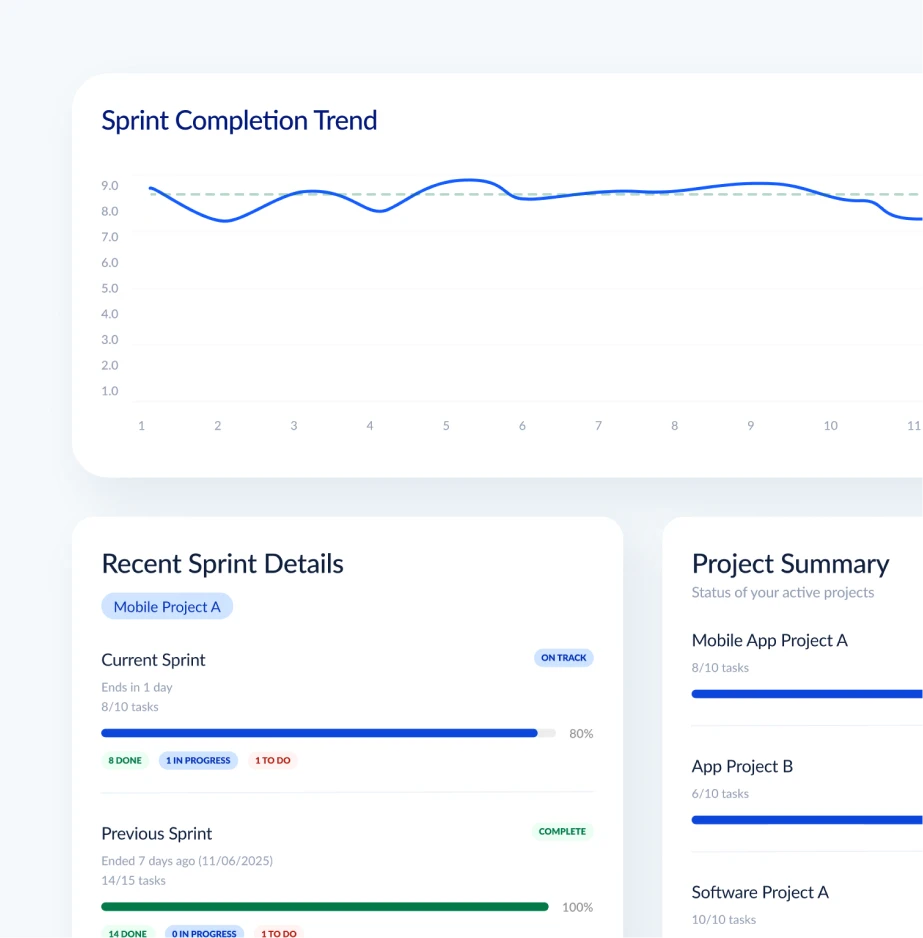
Get real-time development visibility into every sprint through our Software Engineering Orchestration Platform (SEOP). Track velocity, blockers, and delivery health with executive dashboards.

Use Cases

What You Can Build with Backend

Double tick icon

Scale APIs From 1K to 1M Concurrent Users Without Collapse

Systems designed for 1K users fail catastrophically at 1M. Backend developers architect for scale from inception: load balancing across servers, caching layers reducing database strain, query optimization, async processing offloading heavy work, connection pooling. Retrofitting scalability after collapse is expensive and risky. Backend developers anticipate growth, building systems that expand smoothly.
Double tick icon

Execute Complex Business Logic Reliably and Correctly

Payments, fraud detection, subscription billing, multi-step workflows—business logic must be correct. Backend developers implement reliability: transaction management ensuring consistency even during failures, idempotency preventing double-charges from retries, error handling enabling graceful degradation, monitoring detecting anomalies. Incorrect logic costs directly: billing failures lose revenue, fraud detection misses fraud or falsely blocks legitimate transactions.
Double tick icon

Prevent Data Breaches Through Secure Authentication and Authorization

Security breaches—unauthorized access, privilege escalation, session hijacking—stem from backend vulnerabilities. Backend developers implement foundational security: authentication (verifying identity), authorization (enforcing permissions), secure password handling (bcrypt), token management (JWT), and rate limiting (preventing abuse). Security isn't a feature; it's foundational infrastructure protecting users and business from costly breaches.
Double tick icon

Integrate With Third-Party Services and Handle Failures Gracefully

Modern systems depend on external services: payment processors (Stripe), email delivery (SendGrid), analytics platforms. Backend developers manage integration complexity: API authentication, error recovery, rate limit compliance, webhook handling, data transformation. Integration failures are critical incidents; backend developers implement resilience patterns, retry logic, and monitoring enabling rapid detection and recovery.
Double tick icon

Process Large Datasets and Real-Time Events at Scale

Reporting jobs (processing billions of rows overnight), real-time notifications, event streaming, machine learning pipelines—backend developers optimize data processing: batch efficiency preventing timeouts, event ordering handling out-of-order arrivals, managing backpressure (not overloading downstream systems). Real-time and batch systems require different patterns; backend developers select appropriate architectures.
Double tick icon

Maintain System Stability Through Monitoring, Alerting, and Fast Recovery

Production systems fail: databases go down, services respond slowly, external APIs become unavailable. Backend developers build observability: logging (understanding failures), metrics (alerting before user impact), distributed tracing (understanding cross-service request flow), graceful degradation (reducing functionality rather than crashing). Stability is invisible until absent; backend developers prevent absence through proactive monitoring.
Our Process

How to Hire Backend with Scrums.com

Align

Tell us your needs

Book a free consultation to discuss your project requirements, technical stack, and team culture.

Review

We match talent to your culture

Our team identifies pre-vetted developers who match your technical needs and team culture.

Meet

Interview your developers

Meet your matched developers through video interviews. Assess technical skills and cultural fit.

Kick-Off

Start within 21 days

Developers onboard to SEOP platform and integrate with your tools. Your first sprint begins.

Engagement Models

Flexible Hiring Options for Every Need

Whether you need to fill developer skill gaps, scale a full development team, or outsource delivery entirely, we have a model that fits.

Fill Specific Skill Gaps

Augment Your Team

Embed individual developers or small specialist teams into your existing organization. You manage the work, we provide the talent.

Integrate with your existing team
You manage developers directly
Flexible month-to-month contracts
Scale up or down as needed
Quick deployment (<21 days)
Full Teams Managed on SEOP

Dedicated Team

Get a complete, self-managed team including developers, QA, and project management – all orchestrated through our SEOP platform.

Fully managed by Scrums.com PM
Integrated into SEOP platform
Real-time delivery dashboards
Includes PM, Dev, QA roles
Quick deployment (<21 days)
Outcome-Based Delivery

Product Development

From discovery to deployment, we build your entire product. Outcome-focused delivery with design, development, testing, and deployment included.

Full product team (PM, Design, Dev, QA)
Design-to-dev process
2-week sprint cycles
Seamless handoff or ongoing support
Quick deployment (<21 days)
Not sure which model fits your needs? Book a Free Consultation

Access Talent Through The Scrums.com Platform

When you sign-up to Scrums.com, you gain access to our Software Engineering Orchestration Platform (SEOP), the foundation for all talent hiring services.

Browse Backend across 113 technologies

View developer profiles, CVs, and portfolios in real-time

Activate Staff Augmentation or Dedicated Teams directly through your workspace

Scrums.com SEOP platform dashboard showing available talent with talent filtering and real-time hiring capabilities

Need Software Developers Fast?

Deploy vetted developers in 21 days.
Tell us your needs and we'll match you with the right talent.

The Role of Backend in Software Development

What Modern Backend Development Means: Building Reliable, Scalable Systems

Beyond Request-Response Cycles: System Design That Handles Scale, Security, and Complexity

When you hire "backend developers," you're evaluating whether candidates can architect systems handling millions of requests daily while maintaining security, reliability, and correctness. Backend development is not writing SQL queries—it's system design: architectural decisions affecting scalability, security patterns preventing breaches, operational practices ensuring stability.

Backend positions command premium compensation: backend developers earn $20K more than frontend counterparts on average (Glassdoor 2024). This reflects business impact: backend work directly affects revenue (transactions must process correctly), security (breaches cost millions), and reliability (downtime cancels revenue). Backend developers are infrastructure architects: their decisions propagate through all downstream systems.

The core value: invisible reliability and system efficiency. Frontend work is visible to users; backend work is invisible until failure. A broken login blocks all users. A slow database query cascades to slow frontend. A payment processing failure loses direct revenue. A security vulnerability exposes customer data. Backend developers prevent failures, optimize efficiency, and enable features frontend developers expose to users.

Backend development excels in: organizations handling sensitive data (financial, healthcare, identity), companies scaling from startup to enterprise (architecture determines scaling ceiling), applications with complex business logic, systems needing security hardening, and teams building distributed systems. Backend development struggles with: visual design, user experience optimization, or organizations with undefined scaling requirements (premature optimization wastes resources).

At Scrums.com, our backend developers bring production-scale experience: designing database schemas for performance and consistency, implementing authentication and authorization preventing breaches, architecting APIs enabling frontend success, handling async processing and background jobs, optimizing queries reducing response times, and building observability enabling rapid incident response. Whether you need Staff Augmentation to accelerate development, Dedicated Teams for complete backend ownership, or Product Development as a Service, our engineers deliver systems handling scale reliably.

Essential Backend Developer Competencies

System Design, Database Architecture, and Production Operations at Scale

Backend developers master database design, API architecture, asynchronous processing, security implementation, and systems monitoring.

Database Design and Optimization: Relational databases (PostgreSQL, MySQL) or document stores (MongoDB)—data modeling is foundational. Production competency includes: schema design (choosing appropriate data types, normalizing to prevent anomalies), indexing (improving query speed), query optimization (avoiding N+1 problems, understanding execution plans), transaction management (ACID properties, handling concurrent access), and backup/recovery strategies. Poor database design degrades application performance; optimization knowledge separates junior from senior developers.

API Design and REST/GraphQL Patterns: Backend developers expose data through APIs that frontend and mobile clients consume. Competency includes: proper HTTP semantics (GET retrieves, POST creates, PATCH modifies, DELETE removes), status codes (200 OK, 404 Not Found, 500 Server Error), pagination (enabling large dataset fetches), versioning (supporting API evolution), authentication (JWT, OAuth), and error responses (helping clients understand failures). Well-designed APIs make frontend integration seamless; poorly-designed APIs create costly friction.

Authentication and Authorization: Authentication verifies identity (proving you are who you claim); authorization grants permissions (allowing specific actions). Competency includes: password handling (bcrypt hashing, never plaintext), session management (cookies, JWTs, refresh tokens), multi-factor authentication, role-based access control (RBAC), and preventing common attacks (CSRF, XSS via backend). Authorization bugs leak data; backend developers prevent data exposure.

Asynchronous Processing and Background Jobs: Not all work fits request/response cycles. Backend developers handle async patterns: background jobs (sending emails without blocking requests), event-driven architecture (publishing events downstream services consume), message queues (decoupling processing from long-running work), and task scheduling (nightly batch jobs). Async patterns prevent request timeouts while enabling scalability.

System Observability and Incident Response: Production systems fail. Backend developers build observability: structured logging (understanding failures after incidents), metrics (CPU, memory, latency, error rates), distributed tracing (following requests across services), and alerting (notifying teams before user impact). Incident response requires: log aggregation tools (ELK stack, Datadog), metric dashboards (Grafana), and on-call practices (runbooks, escalation policies).

Scalability Architecture Patterns: Single servers have limits. Competency includes: load balancing (distributing traffic), caching strategies (Redis, memcached reducing database load), database replication (spreading read load), sharding (partitioning data for horizontal scaling), and microservices patterns (decomposing monoliths into independent services). Architecture decisions made early (monolith vs. microservices, SQL vs. NoSQL) compound through growth; backend developers make scalability-aware decisions.

Business Value of Backend Development: Revenue Protection and Growth Enablement

Three Critical Outcomes From Quality Backend Architecture

Uptime Directly Protects Revenue: For online businesses, downtime is lost transactions. One hour of downtime (at $10K/hour revenue) costs $10K—equivalent to one engineer's annual salary. Backend developers building reliable systems prevent downtime; fast incident response minimizes duration when failures occur. Reliability directly protects revenue.

Scalability Enables Organic Growth Without Expensive Rebuilds: Startups scaling from 1K to 1M users need architecture supporting 1000x growth. Backend developers anticipating growth build systems scaling smoothly; applications designed for 1K collapse at 1M, requiring costly rewrites. Scalability planning is growth enablement: early architecture decisions prevent mid-flight disasters.

Security Prevents Catastrophic Breaches: Data breaches average $4.9M in direct costs (IBM 2023), plus regulatory penalties (GDPR: up to 4% revenue), customer churn, and brand damage. Backend developers implementing proper authentication, authorization, secure data handling, and compliance patterns prevent breaches. Security is ROI: preventing one breach justifies years of security discipline.

Reliability Builds Customer Trust and Retention: Unreliable systems (frequent outages, slow performance, errors during critical operations) erode trust. Backend developers delivering reliable, fast systems build confidence. Customer retention improves when systems are dependable; reliability is directly retention.

Observability Enables Rapid Problem-Solving and Competitive Advantage: Organizations without observability debug blindly; "users report slowness" without understanding cause. Backend developers instrumenting systems enable rapid diagnosis: identifying slow queries, finding bottlenecks, discovering integration failures. Fast diagnosis = fast resolution = minimal customer impact. Observability is competitive advantage: faster recovery = better customer experience.

Microservices Architecture and Distributed Systems

Decomposing Monoliths Into Independently Scalable Services

Monolithic applications bottleneck: scaling one slow component requires scaling entire application. Microservices decompose applications into independent services: each deployable separately, scalable independently, developed by independent teams. Patterns: service discovery (services finding each other), inter-service communication (HTTP, gRPC, message queues), distributed transactions (coordinating updates across services), and circuit breakers (preventing cascading failures). Microservices introduce complexity; the cost is worth it in large organizations but premature in startups.

Data Consistency and Event-Driven Architecture

Maintaining Correctness in Distributed Systems Without Synchronous Locks

Distributed systems face consistency challenges: databases can't synchronize instantly across regions. Patterns like event sourcing (recording all changes as events) and CQRS (separating read and write models) maintain consistency without requiring synchronous locks. Backend developers understand CAP theorem tradeoffs: systems can guarantee consistency (C) or availability (A), but not both in partitioned networks (P). Architecture decisions reflect business priorities: financial systems prioritize consistency (correctness required), social media prioritize availability (users can always post).

Cost Optimization and Infrastructure Efficiency

Reducing Operational Expenses Through Efficient System Design

Cloud infrastructure costs scale with resource usage. Backend developers optimize: choosing database indices (faster queries = less CPU), caching effectively (reducing database load = lower costs), designing for efficiency (well-written code runs in less time = lower bills). Organizations can waste 2x on infrastructure due to inefficient queries, over-provisioned resources, or poor caching. Backend optimization directly reduces operational expenses without compromising performance.

Backend developers build systems handling scale reliably, securely, and cost-effectively. Our backend engineers design database architecture, expose data through well-designed APIs, implement security preventing breaches, architect for scalability, and build observability enabling stability. Applications live or die based on backend quality.

Want to Know if Scrums.com is a Good Fit for Your Business?

Get in touch and let us answer all your questions.

Get started

Find Related Software Developer Technologies

Our Blog

Explore Software Development Blogs

The most recent trends and insights to expand your software development knowledge.