Between 10 May and 9 June 2026, a fleet of specialised AI engineering agents deployed through the Scrums.com AI Agent Gateway analysed 987,151 lines of legacy code across 5,055 files, mapped 858 sub-systems, and delivered the equivalent of 11,058 senior-engineer hours, roughly 5.4 years of senior developer output, in under 150 hours of machine time. That is a 75x velocity gain, achieved entirely inside the client's own AWS environment.
This case study breaks down the numbers, the architecture, and the engagement model for technology leaders in banking, financial services and insurance (BFSI) who want to introduce AI into complex, regulated environments without compromising security, governance or compliance.
What is the Scrums.com AI Agent Gateway?
The Scrums.com AI Agent Gateway is a governed fleet of specialised AI engineering agents, covering discovery, scoping, build, code review, architecture and security, connected by a persistent, role-based memory layer and deployed inside your own AWS account via Amazon Bedrock. It gives regulated enterprises AI-driven engineering velocity without code or data ever leaving their security perimeter.
Unlike standalone coding assistants, the Gateway solves the real bottleneck in enterprise software delivery: context. Individual AI tools fail in large organisations because they have no persistent architectural memory. The AI Agent Gateway maintains a shared, searchable context layer for every engineering task, governed by role-based access control and native to the Model Context Protocol (MCP).
The Gateway is part of the Scrums.com Software Engineering Orchestration Platform, which integrates with the tools BFSI teams already run: Jira, Confluence, Bitbucket, GitHub, and supports both Kanban and sprint-based workflows.
The Challenge: AI in a Complex, Regulated Banking Environment
BFSI engineering leaders face a specific version of the AI adoption problem:
- Decades of legacy code, including systems that pre-date Git, with the original authors long gone and documentation missing or out of date.
- Security teams that are rightly sceptical of Large Language Models, citing prompt injection risk, data leakage and uncontrolled tool execution.
- Restrictive sandbox environments that block the full software delivery cycle and stall AI pilots before they show value.
- CFO-level scrutiny: every AI initiative must show measurable return on investment, not demos.
The client in this engagement, a leading financial services group, needed to migrate legacy APIs and rebuild consistent data models across more than a million lines of code spread over 5,000+ files. Done manually, their architects estimated it would take a "war room" of 40 or more senior engineers months of work.
The Results: 75x Velocity, 11,058 Engineering Hours Saved
Over a 30-day window (10 May to 9 June 2026), the AI agent fleet delivered:
| Metric | Result |
|---|---|
| Engineering hours saved | 11,057.93 hours |
| Velocity vs manual delivery | 75x |
| Senior developer equivalent | 70 senior developers working full-time for 1 month |
| Workdays recovered | 1,382 days |
| Machine time used | ~148.8 hours |
| Equivalent senior output | 5.4 years of senior developer output in 30 days |
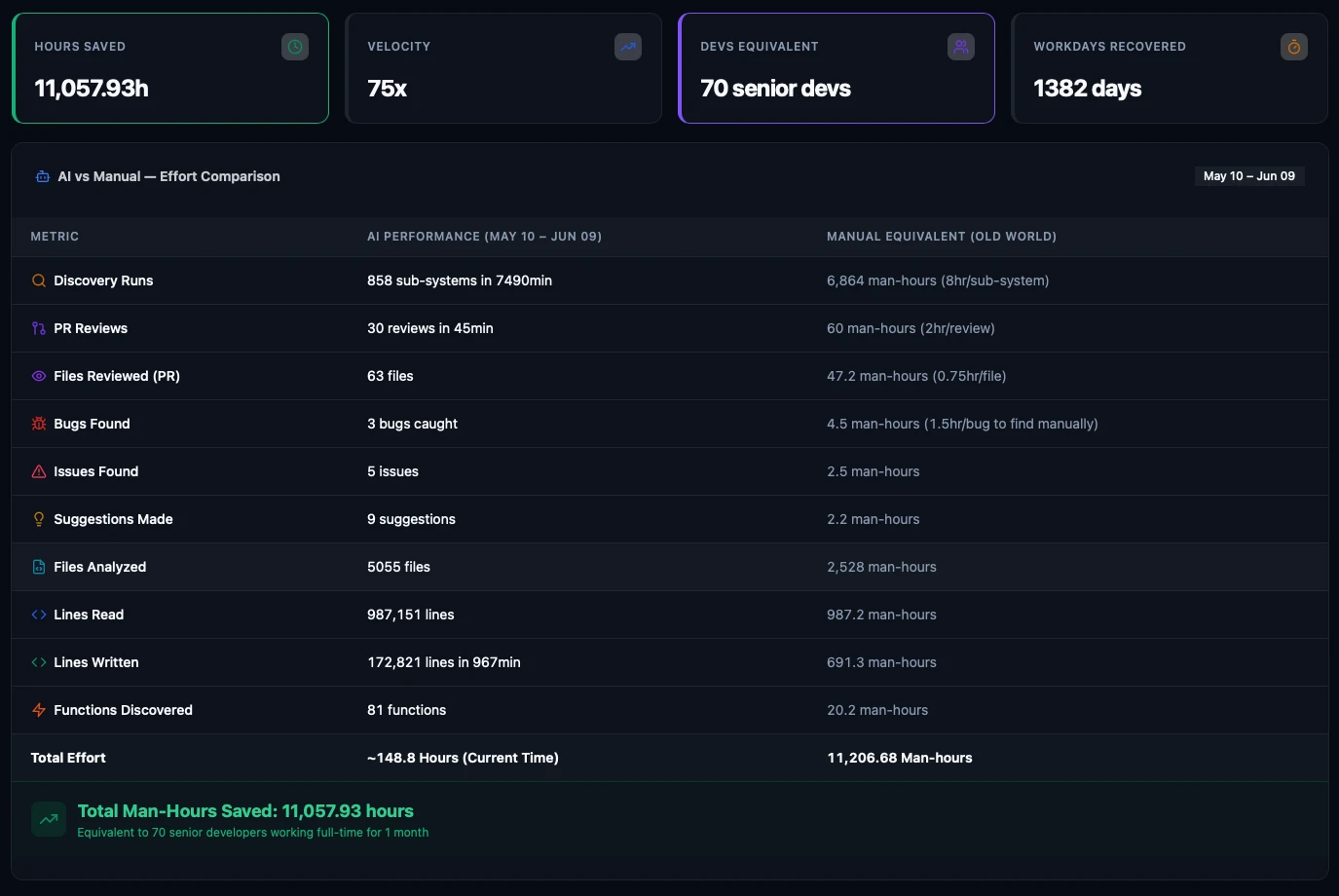
AI vs manual effort, line by line
The effort comparison above is built from measured agent activity against standard senior-engineer benchmarks:
- Discovery: 858 sub-systems documented in 7,490 minutes of machine time, an estimated 6,864 man-hours done manually at 8 hours per sub-system.
- Code analysis: 5,055 files and 987,151 lines of legacy code read, indexed and mapped into searchable documentation.
- Code generation: 172,821 lines written in 967 minutes, work benchmarked at 691 man-hours.
- Code review: 30 pull requests covering 63 files reviewed in 45 minutes, catching 3 bugs and 5 issues before production, with 9 improvement suggestions posted directly as PR comments.
Total measured effort: roughly 148.8 hours of machine time against an estimated 11,206.68 man-hours of equivalent manual work.
Platform reliability at enterprise scale
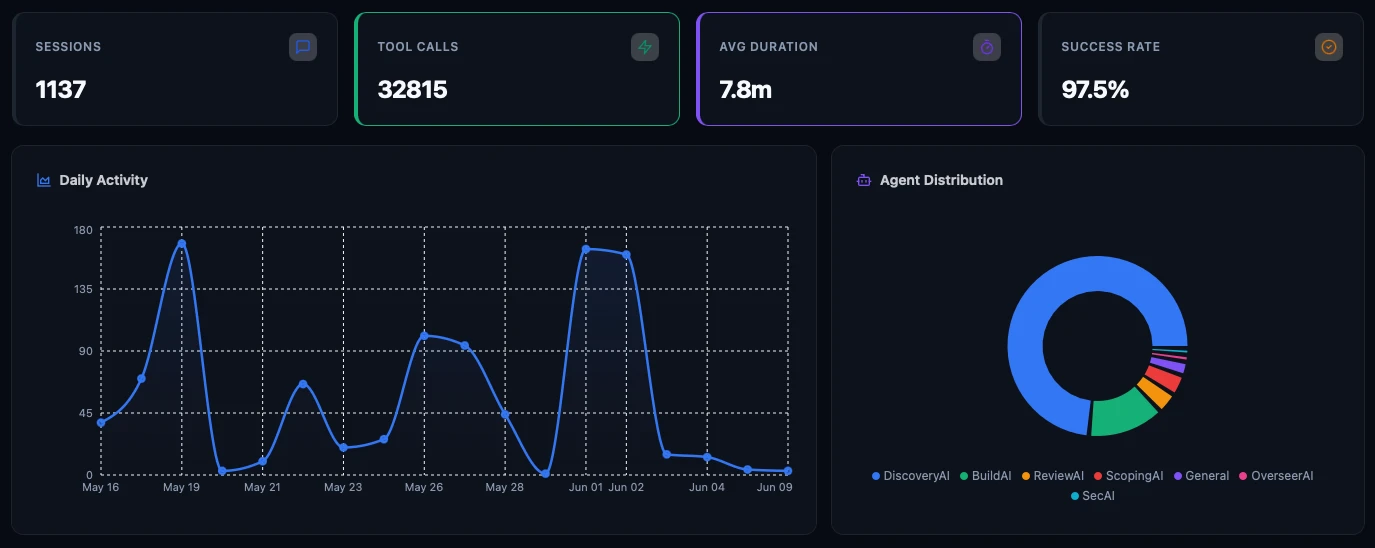
Across the same period the platform ran 1,137 agent sessions and 32,815 tool calls with a 97.5% success rate and a 7.8-minute average session duration. This is production-grade reliability, not a lab demo, across a working fleet of discovery, build, review, scoping and security agents.
How It Works: A Governed Fleet of Specialised AI Agents
The AI Agent Gateway is not one model doing everything. It is an orchestrated fleet of role-specific agents, each with scoped tool access, coordinated by an orchestration agent and grounded in a shared memory layer:
| Agent | Role in the delivery pipeline |
|---|---|
| DiscoveryAI | Excavates legacy systems (including unstructured data and codebases outside Git) and turns them into clear, cited documentation with file-and-line traceability. |
| ScopingAI | Converts requirements into bulletproof scope documents: business flows, edge cases, validation rules and full test scenarios. |
| BuildAI | Generates production code from scope documentation through a six-phase gated workflow, and keeps debugging until the code actually runs. |
| ReviewAI | Reviews pull requests in GitHub and Bitbucket, enforcing coding standards automatically before a senior human review. |
| TestAI | Generates and runs unit and feature tests, committing them through standard Git workflows. |
| ArchitectAI & SecAI | Independent architectural reviews and static-analysis security audits with severity-rated findings and remediation guidance. |
| OverseerAI | Orchestrates the fleet: decomposing requests, dispatching specialists in parallel and consolidating verified results. |
A persistent memory layer ties the fleet together. The system periodically consolidates and prunes its own memory, rating contributions so high-value architectural knowledge is retained while low-value noise is discarded. Cost stays controlled because context engineering lets the platform run efficient everyday models for most tasks instead of expensive frontier models.
Security and Compliance: Why BFSI Teams Approve This Architecture
Security review is usually where enterprise AI projects die. The AI Agent Gateway was designed for that conversation:
- Your AWS account, your perimeter. The Gateway runs on Amazon Bedrock inside the client's own AWS environment. Code and data never leave your infrastructure, and AI consumption is billed and monitored through your own AWS account.
- Containerised agent execution. Agents build and ship code inside containers, removing the need for external build tools and addressing prompt-injection and sandbox-escape concerns raised by security teams.
- Role-based access control on memory. The shared context layer is governed by RBAC, so agents and people only see what they are entitled to see.
- Read-only where it matters. Discovery and audit agents never modify source code; every claim they make is backed by a file-and-line citation.
- Security alignment before kickoff. Scrums.com runs a dedicated pre-engagement phase with your CISO and security teams: architecture deep-dives, deployment and testing reviews, before the project formally begins. Our team has navigated these reviews with some of the most demanding security organisations in financial services.
The Engagement Model: 1-Month Setup, 3-Month Proof of Concept
BFSI organisations don't buy promises; they buy evidence. The engagement is structured so you see measurable results before committing to broader rollout:
| Phase | Duration | What happens |
|---|---|---|
| Phase 0: Security alignment | Pre-engagement | Architecture and security deep-dives with your CISO, compliance and governance teams. Approval secured before kickoff. |
| Phase 1: Setup & onboarding | 1 month | Platform deployment into your AWS environment, codebase ingestion, automated discovery, and team onboarding through an outcome-driven sprint. |
| Phase 2: Proof of concept | 3 months | The agent fleet runs against a real migration or modernisation target (for example, legacy API migration) with ROI dashboards reporting hours saved, velocity and success rate throughout. |
What's included in the recommended package
The recommended Scrums.com configuration for BFSI teams introducing AI:
- Software Engineering Orchestration Platform: real-time delivery visibility, unbiased team and project data, and integration with Jira, Confluence, Bitbucket and GitHub.
- AI Agent Gateway: the full governed agent fleet with persistent memory, deployed in your AWS account via Amazon Bedrock.
- Onboarding outcome-driven sprint: a structured first sprint on the Software Engineering Orchestration Platform that targets a concrete delivery outcome, not a training course.
- Forward Deployed Architect: a senior Scrums.com architect embedded with your team to run discovery, configure the agent fleet, navigate security reviews and supercharge your development teams from day one.
Scale up or down without long-term lock-in: the model is explicitly designed so you can evaluate results at the end of the proof of concept before committing further.
Who Uses the AI Agent Gateway?
The AI Agent Gateway and the Scrums.com Software Engineering Orchestration Platform are used by engineering organisations across the globe, from global technology investors like Prosus to payments providers like Payfast, alongside banks, insurers and financial services groups across Africa, the UK and the US. The metrics in this case study come from a live 30-day engagement with a leading financial services group, measured directly from the platform's ROI dashboards.
About Scrums.com
Scrums.com is the Software Engineering Orchestration Platform (SEOP). Mission control for engineering and product leaders. Instantly deploy AI agents, talent, teams, tools, infrastructure, and delivery operations from one platform with live engineering intelligence, unified reporting, and predictable software delivery. One contract. One SLA. One deploy.
Software Engineering. Sorted.™
Frequently Asked Questions: AI Agents in Banking and Financial Services
Are AI coding agents safe to use in a regulated banking environment?
Yes, when deployed correctly. The Scrums.com AI Agent Gateway runs inside your own AWS account on Amazon Bedrock, so code and data never leave your security perimeter. Agents execute inside containers with role-based access control, and discovery and audit agents are read-only. Scrums.com also runs a dedicated security alignment phase with your CISO and compliance teams before any engagement begins.
How long does it take to implement the AI Agent Gateway?
Setup and onboarding take one month: platform deployment into your AWS environment, codebase ingestion, automated discovery and an outcome-driven onboarding sprint. A three-month proof of concept follows, with ROI dashboards reporting hours saved, velocity and success rates throughout, so you evaluate evidence before committing to broader rollout.
What ROI can banks expect from AI engineering agents?
In a measured 30-day BFSI engagement, the AI Agent Gateway saved 11,057.93 engineering hours, a 75x velocity gain equivalent to 70 senior developers working full-time for a month, using under 150 hours of machine time. It analysed 987,151 lines of legacy code across 5,055 files and maintained a 97.5% success rate over 32,815 tool calls.
Can the AI Agent Gateway handle legacy systems that aren't in Git?
Yes. DiscoveryAI ingests unstructured data directly from file systems and databases, not just Git repositories. It translates complex legacy structures, including cryptic abbreviations and non-English code terms, into clear, indexed documentation, with every claim backed by a file-and-line citation.
Which large language models does the platform use?
The platform uses a mix of models matched to each task to optimise cost and performance. Because the shared memory layer provides rich context, most work runs on efficient everyday models rather than expensive frontier models, keeping token costs manageable. All model consumption runs through Amazon Bedrock in your own AWS account, billed and monitored by you.
What does the AI Agent Gateway cost?
Pricing is structured around a platform subscription, the AI Agent Gateway licence, and a one-month discovery and onboarding engagement, with LLM consumption billed at cost through your own AWS account. Book a free workshop for a detailed cost breakdown and an ROI case tailored to your environment.
How is this different from giving developers GitHub Copilot or a coding assistant?
Coding assistants help one developer write code faster. The AI Agent Gateway is an orchestrated fleet of specialised agents: discovery, scoping, build, review, testing, architecture and security, that share a persistent, governed memory of your entire codebase. The bottleneck in enterprise delivery isn't typing speed; it's context. The Gateway solves the context problem.
Book a Free AI Agent Gateway Workshop
See the agent fleet run against your own codebase. In a free workshop, a Scrums.com Forward Deployed Architect will walk your team through the discovery process, the security architecture, and an ROI projection based on your environment.